

Virtual reality studio · Zaragoza, Spain · Our own game
Escape the Urban Underground: the horror VR escape room we built
A murder in an abandoned subway station, three rooms and two ways to play, on Meta Quest and PC VR. Developed and self-published by OverFuture.
A horror escape room set around a crime scene. Requires a virtual reality headset.
 (opens in a new tab)
Trailer · 1:26 No cookies until you press play
- 3 rooms in the station
- 60 min on the clock
- 5 languages
- 558 automated tests
The case
The game, and the studio behind it
Escape the Urban Underground is a horror escape room for virtual reality. We're OverFuture, a studio in Zaragoza, Spain. We built it in Unity and published it ourselves, and it doubles as our end-to-end case study in VR game development.
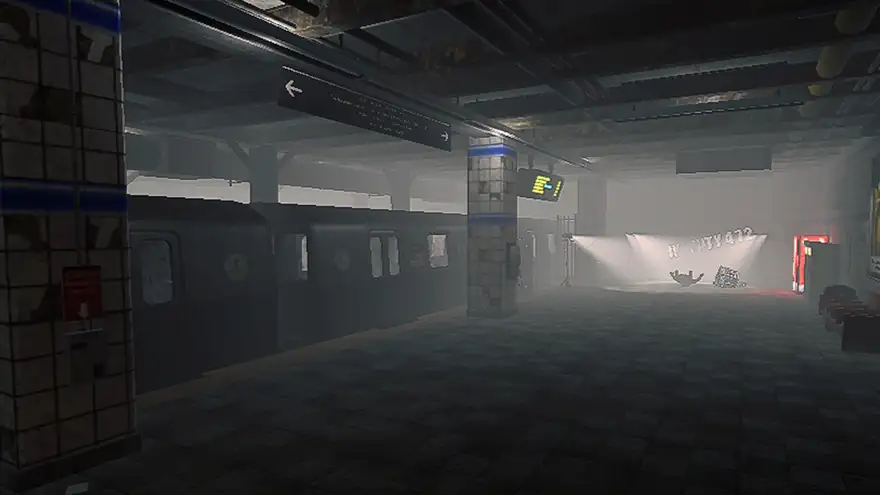
Beneath a city that never goes quiet, a subway station has been closed for decades. A murder has just taken place on its platforms. Your job is to look around, piece together what happened and find the way out.
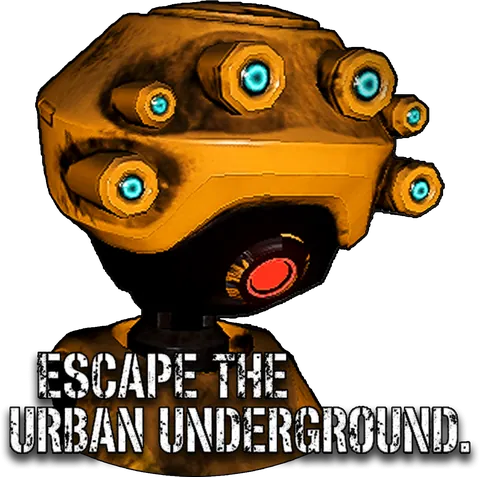
RAID · on arrival at the station“Hi, I'm Raid, your support unit for this investigation. Officer Cross, location secured. Reading vital signs. Negative. The subject is dead. Come on, follow me.”
It's single-player and VR only, available on the Meta Quest Store and on Steam (PC VR, Windows).
Got a virtual reality game in mind?
We reply within 24 business hours.
Virtual reality projects start at €4,500, excluding VAT. The final price depends on the number of scenes, the level of interaction, the target headsets and the 3D content.
- Genre
- Horror escape room
- Platforms
- Meta Quest and PC VR
- Engine
- Unity and C#
- PC VR
- OpenXR with SteamVR
- Modes
- 60-Minute Challenge or Relaxed Mode
- Languages
- Five (voice-over in English and Spanish)
- Players
- Single-player
- Publisher
- OverFuture, Zaragoza
Timeline
From the first attempt to the big update
Launch on Meta Quest
The trailer comes out and the game arrives on the Meta Quest Store.
Launch on Steam
The PC VR release. The full story is in our development write-up (opens in a new tab).
The big update
Relaxed Mode, Continue, interactive hints and three more languages. Full details in the update post (in Spanish) (opens in a new tab).
- Today
Available on two stores
Available on the Meta Quest Store and on Steam, with both modes and five languages.
Challenge 1 · The clock
60-Minute Challenge: a clock that talks, and only one attempt
The game started with one hard rule: a single 60-minute attempt, just like a real escape room. The clock is on the station walls, and RAID, your support unit, warns you out loud when 45, 30 and 15 minutes are left. At 00:00 the attempt is over.
In virtual reality that comes at a cost: a session can also end because you get tired or because someone calls you. So we added Relaxed Mode without touching the challenge: it has no clock and saves automatically at checkpoints the game chooses.
Try it yourself in the simulator. The clock runs fast and drops to real time whenever RAID speaks, so you hear each warning in full. Then close the app in each mode and see what is kept.
- Result
- A challenge with real tension and a mode for people who play in short bursts, in the same game and without duplicating content.
- For your project
- Before any art is made, we decide how long a session lasts and what happens if it is cut short: nothing changes the experience in a headset more. Tell us about your project
60:00
RAIDPress “Start the attempt”.
- Room 1Platform
- Room 2Terminals
- Room 3Train cars
One 60-minute attempt. If you close the app, the attempt is lost.
Does your game need this? Tell us about your projectSimulation: here, an hour of play takes just over a minute and a half. The room names are approximate: no spoilers.
The clock warnings, exactly as they sound in the game
- 45:00
RAID · 45 minutes left“General Cross, the first 15 minutes are gone. We need to hurry. We can't afford to lose our pace.”
- 30:00
RAID · 30 minutes left“General Cross, we have exactly half an hour left. We must hurry. Time is running out and this is getting complicated.”
- 15:00
RAID · 15 minutes left“General Cross, only 15 minutes. Please, we have to hurry. Time is running out. We need to get out of here now.”
- 00:00
End-of-attempt sound · 24 secondsNot a RAID line: the clock hits zero and the game is over.
Challenge 2 · RAID
A voice assistant that helps without solving the puzzle
In an escape room, a hint at the wrong moment kills the puzzle, and a hint that never comes kills the game. The design document, written in Spanish, settled this from day one. Translated, it says RAID “will not help with any puzzle or objective, but it will give help with its voice when the player is very lost or is taking a long time”.
In the code, that comes down to 11 phases and two channels. The automatic channel only speaks once you have been stuck for a while: between 3 and 8 minutes depending on the phase, give or take 30 seconds so it doesn't feel like a timer. The manual channel answers when you walk up to RAID and press the button.
RAID stays quiet if it is already speaking, if a menu is open or if the player has switched voice hints off, and the visual hints carry on separately. Once you solve something, its hints are gone: RAID never explains what you have already done, not even after a Continue.
- Result
- 38 hint lines in two languages, 11 phases, two channels and 40 automated tests in 5 files that check when RAID speaks and when it stays silent.
- For your project
- The help policy is decided before a single line is recorded: how long it waits, which channel it uses and how it switches itself off. It works for escape rooms, training, simulators and guided tours. Tell us about your project
Hint console “Locked box” phase
Time without progress (the automatic hint comes at around 3:00)
RAIDPress “Start the phase”.
In the game, this phase waits 3 minutes, give or take 30 seconds; here, those 3 minutes take 9 seconds.
The four lines from this phase, one at a time
Automatic hint 1“General, a poster promoting fruit in an abandoned subway station? That is too out of place to be a coincidence.”
Automatic hint 2“There is something unusual about the graffiti on these walls. That fresh paint might be trying to tell us something about the murder, sir.”
Manual hint 1“General Cross, the victim belonged to the Alcon unit. They were trained to protect this maximum security box with their lives. The code can't be far. Perhaps the crime scene hides more details on this platform.”
Manual hint 2“An Alcon unit operative never memorises these pass codes without leaving a contingency trail. They must have noted the code down near where they fell, likely disguised as a riddle in the station.”
Challenge 3 · Puzzles
Clues in the environment, not in a list
A VR escape room has to put your hands to work. You restore power to transport terminals, solve geometric security panels and get through train cars full of obstacles.
The information is spread around the station. There is no separate task list: you have to look closely and touch things.
The hints live in the space too, and RAID comments on what you see in each room. When you get stuck, RAID points you to the next thread but never does the work for you. Listen to what it says in each room.
The tension comes from flickering lights, distorted audio and shadows. They support the puzzles without replacing them. We go into it in our post on designing immersive horror in VR (in Spanish) (opens in a new tab).
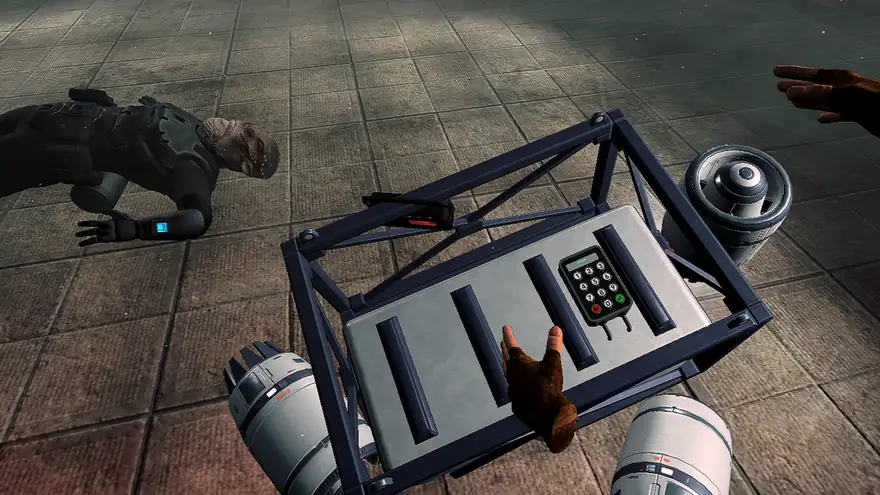
Room 1 · Platform“The walls are covered in graffiti. I'm sure if we look closely, one of them will give us a clue.”
Room 1 · when you get it right“Unbelievable, you actually cracked the code. Great job.”
Room 2 · Terminals“Looks like they went through a lot of trouble to take over the station. Officer Cross, check out those panels. The numbering on them is really weird.”
Room 3 · Train cars“The train cars at the back seem to be hiding some secrets inside. We need to figure out how to get in.”
Challenge 4 · Quality
558 automated tests for a game that can't break mid-session
A bug in a checkpoint or in the clock ruins an hour-long session. That is why the project has 558 automated tests in 106 files, covering 93 scripts we wrote ourselves.
They cover Relaxed Mode, the checkpoints, gameplay after a restore, the hands and a broad QA pass. They run in the editor before every release.
The 60-minute clock is built with the headset in mind as well. It fires its warnings at specific minutes and draws its digits without allocating memory every frame, so there is no stutter.
What the 558 tests cover
- Relaxed Mode No time limit, with checkpoints.
- Checkpoints Saving and restoring the 42 pieces of state.
- Continue Start-up with headset, controllers and height.
- Hands Grabbing and interaction.
- QA Full playthroughs in the editor.
The process
How we develop virtual reality games with Unity in Zaragoza
The session comes first
Before any art, we decide how long a session lasts and what happens if it is cut short.
See the two modesA space that tells the story
The clues and the story live in the environment, not in menus.
See the puzzlesTested like software
Automated tests for everything that must not break.
See the testsShip and listen
Two stores, one big update and five languages.
See the timeline
The technology
A VR escape room built with Unity
We are a virtual reality and software studio in Zaragoza, Spain. This is what the game runs on.
Unity and C#
93 scripts of our own and 29,594 lines of code.
OpenXR and SteamVR
PC VR on Windows x64, with headset recovery and suspend support.
Meta Quest
A dedicated build for the standalone headset.
HurricaneVR
Physics-based hands to grab and handle objects.
Our own checkpoints
Versioned save schema and a Continue that checks before it restores.
Localisation
Interface and subtitles in five languages, voice-over in English and Spanish.
VR game and escape room development
- VR developmentHands, physics and performance in the headset. (opens in a new tab)
- Unity developmentGames and apps for PC, mobile and virtual reality. (opens in a new tab)
- Games for Meta Quest (ES)From prototype to the Meta Quest Store. (opens in a new tab)
- Virtual reality in Zaragoza (ES)Built at our studio on Calle Pablo Remacha. (opens in a new tab)
The result
What you'll find in the station today
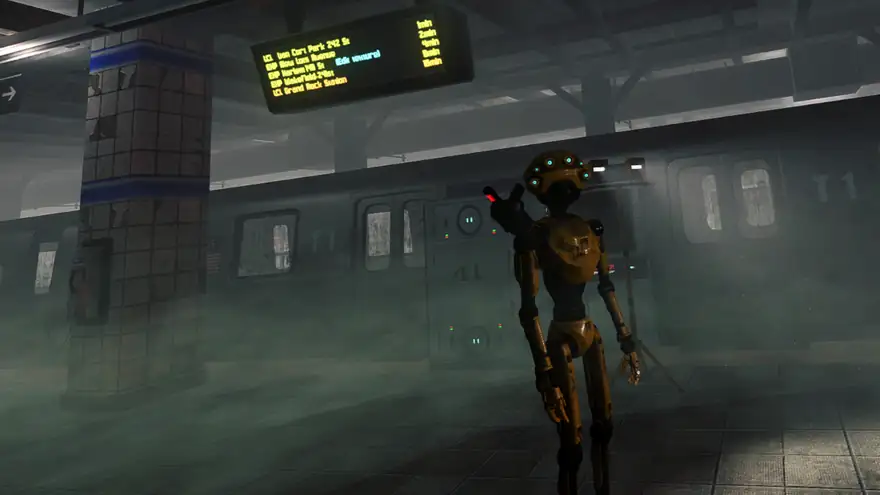
You are not alone in the station. RAID“Officer Cross, there is an extreme risk of death. You are not authorized to continue using my services. If you proceed, you're on your own. The defunct Falcon unit has been assigned to the conspiracy team. Objective reclassified. Evacuate.”
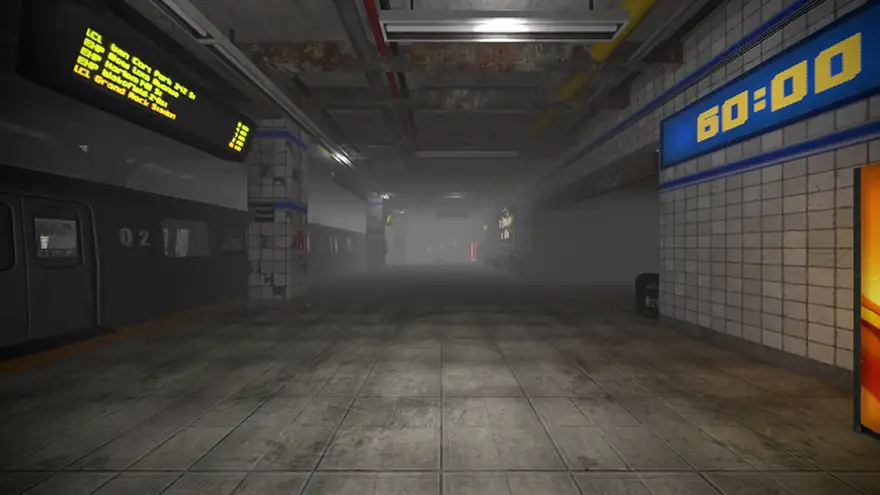
The 60-minute clock, on the wall as well. RAID“Enjoy the show!”
Escape the Urban Underground is available on the Meta Quest Store and on Steam. It has two modes, built-in hints and five languages.
How we built it: the development story (opens in a new tab) · See the project page (in Spanish) (opens in a new tab)
FAQ
What people ask us most about Escape the Urban Underground
Who developed Escape the Urban Underground?
OverFuture, a software and video game development company based in Zaragoza, Spain. We designed it, programmed it in Unity and published it ourselves on the Meta Quest Store and on Steam.
Which headsets does it run on?
On Meta Quest, from the Meta Quest Store, and on PC VR with Windows x64, from Steam. The PC version uses OpenXR with the SteamVR runtime and requires a headset.
How long does a playthrough take?
In the 60-Minute Challenge, a single attempt of up to 60 minutes. In Relaxed Mode there is no time limit, and you can quit and continue from the last checkpoint.
Which languages is it available in?
Five. English and Spanish (Spain) have full voice-over; French, German and Simplified Chinese have the interface and subtitles.
Do you develop escape rooms or VR games for clients?
Yes. We develop custom virtual reality games and apps with Unity, for Meta Quest and PC VR. What we solved here (timed sessions, checkpoint saves and an assistant that gives hints without solving the puzzle) also works for training, simulators and guided tours. Tell us your idea in the form and we will suggest how to get started.
How much does it cost to develop a virtual reality game?
It depends on the scope. Our virtual reality apps start at €4,500, excluding VAT. The final price depends on the number of scenes, the level of interaction, the target headsets and the 3D content.
Is your next game in VR?
Tell us about it, even if it's still a room sketched on paper. We'll suggest how to get it onto headsets and into the stores.
More of our work in video game development (in Spanish) (opens in a new tab).